Introduction: Unpacking the Python Developer vs Python Programmer Debate
The world of software creation is filled with nuanced titles, and few distinctions spark as much discussion as the difference between a Python developer and a Python programmer. On the surface, both roles write code in the same language, using similar syntax and libraries. However, the scope, responsibilities, and end goals of each position vary significantly. For hiring managers, understanding the Python developer vs Python programmer dynamic is crucial for building effective teams. For aspiring coders, knowing these differences can shape your learning path and career trajectory. While a Python programmer might excel at algorithms and data manipulation, a Python developer typically architects entire systems. This comprehensive guide will dissect seven core differences, exploring how each role approaches problem-solving, collaboration, and project delivery. By the end, you will have a clear framework to distinguish between a Python developer and a Python programmer, regardless of the job description.

Defining the Core Roles: What Does a Python Programmer Actually Do?
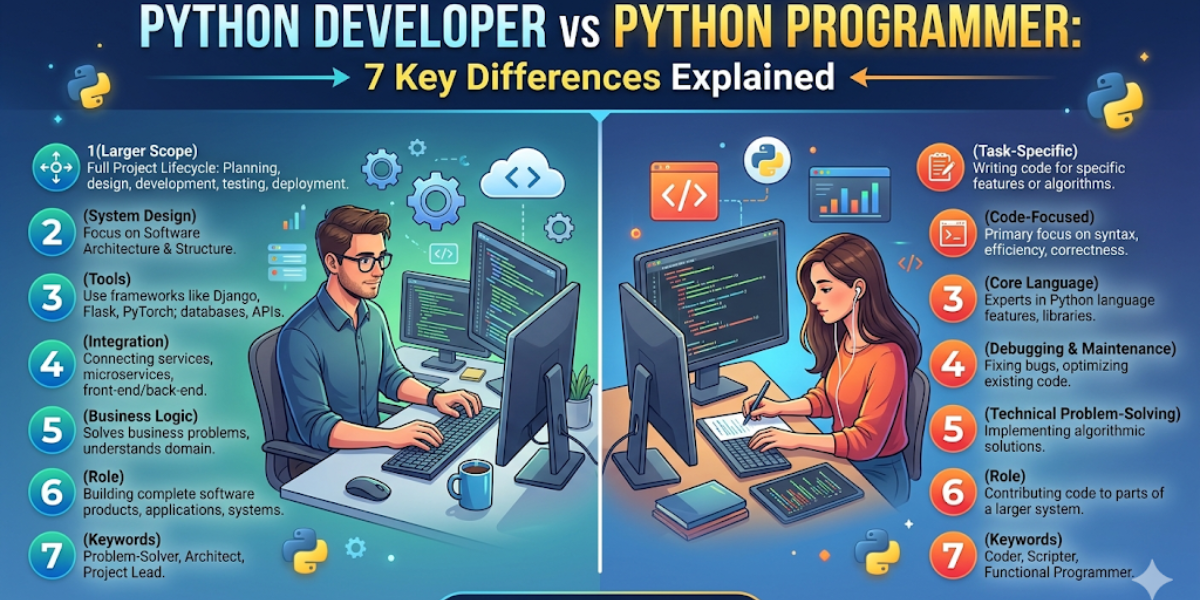
Before diving into contrasts, we must define the baseline. A Python programmer is primarily focused on writing code that executes a specific set of instructions efficiently. Their world revolves around logic, syntax, and computational thinking. When you ask a Python programmer to solve a problem, they will zero in on the most performant algorithm, the cleanest function, or the most elegant recursive solution. They are masters of control flow, data structures, and standard libraries. However, a Python programmer may not always concern themselves with the broader ecosystem—how the code integrates into a web server, how users interact with it, or how it scales under load. In contrast, a Python developer takes that same efficient code and transforms it into a deliverable product. The Python developer vs Python programmer distinction often appears in startup environments: the programmer optimizes the core engine, while the developer builds the steering wheel, pedals, and dashboard around it. Understanding this foundational difference is the first step toward respecting both roles.
Key Difference 1: Scope of Responsibility – From Script to System
The most significant divergence in the Python developer vs Python programmer comparison lies in scope. A Python programmer typically owns a script, a module, or a specific function. Their responsibility begins with a requirement (“parse this CSV file”) and ends with an output (“return the calculated average”). They ensure the code runs without errors and meets performance benchmarks. A Python developer, on the other hand, owns the entire application lifecycle. This means a Python developer must consider version control, database integration, API design, security, logging, and deployment pipelines. Where a Python programmer writes a sorting algorithm, a Python developer integrates that algorithm into a Django view, connects it to a PostgreSQL database, sets up asynchronous task queues with Celery, and deploys the whole stack to AWS. The Python programmer asks, “Does this function return the correct value?” The Python developer asks, “Does this feature work for 10,000 concurrent users without breaking the server?” This expanded scope requires a Python developer to think like a systems architect, not just a coder.
Key Difference 2: Tooling and Environment – IDEs vs Full Stacks
Another practical difference emerges in tooling. Both a Python programmer and a Python developer use integrated development environments (IDEs) like PyCharm, VS Code, or Jupyter Notebooks. However, the Python programmer often relies heavily on computational tools—pandas for dataframes, numpy for numerical arrays, or matplotlib for quick visualizations. Their environment might be a single .py file or a Jupyter notebook with cells. Conversely, a Python developer lives in a project ecosystem. They use pipenv or poetry for dependency management, docker for containerization, pytest for unit and integration testing, and git for branching strategies. A Python developer also works with frameworks like Django, Flask, or FastAPI, which impose structure beyond raw Python. When a Python programmer needs a web interface, they might hack together a simple Streamlit app. When a Python developer needs a web interface, they build a production-grade REST API with OpenAPI documentation. The Python developer vs Python programmer toolset therefore reflects their end goals: one optimizes for computational accuracy, the other for system reliability and user delivery.
Key Difference 3: Collaboration and Soft Skills – Lone Coder vs Team Player
Collaboration patterns sharply divide the Python developer from the Python programmer. A Python programmer often works independently, perhaps as a data analyst, scientific researcher, or automation engineer. Their stakeholders are usually technical peers or direct managers. They submit code via email or a shared drive, and their success is measured by output correctness. In contrast, a Python developer almost always works on a cross-functional team. This means daily stand-ups with project managers, code reviews with senior developers, collaborative debugging sessions with QA engineers, and design discussions with UX designers. A Python developer must write user stories, estimate task complexity using agile points, and document their APIs for front-end developers. Soft skills like communication, empathy, and conflict resolution are non-negotiable for a Python developer. While a Python programmer can thrive as a solitary specialist, a Python developer who cannot explain technical trade-offs to a product owner will fail. This social dimension is often underappreciated in the Python developer vs Python programmer debate, yet it determines team chemistry and project velocity.
Key Difference 4: Problem-Solving Approach – Algorithmic Purity vs Practical Trade-offs
When faced with a problem, a Python programmer seeks the mathematically optimal solution. They might spend hours refining a recursive descent parser or minimizing time complexity from O(n²) to O(n log n). Elegance, brevity, and performance are paramount. A Python developer respects these values but adds a layer of pragmatism. They must balance algorithmic purity against delivery deadlines, code readability against cleverness, and theoretical scalability against actual user loads. For a Python developer, a solution that works, passes tests, and can be understood by a junior developer in six months is often superior to a hyper-optimized but esoteric one. Moreover, a Python developer considers trade-offs that a Python programmer might ignore: Will this third-party library introduce a security vulnerability? Does this micro-optimization make the code harder to maintain? Can we reuse an existing internal API instead of writing new logic? The Python developer vs Python programmer mindset thus mirrors the tension between academic computer science and software engineering. One values truth; the other values utility.
Key Difference 5: Output and Deliverables – Code Snippets vs Production Assets
Look at the final output of each role, and the Python developer vs Python programmer distinction becomes concrete. A Python programmer delivers scripts, functions, notebooks, or command-line tools. These artifacts are often consumed by other technical people or run in batch processes. They may never have a graphical user interface. A Python developer, however, delivers production assets: web applications, mobile backends, API gateways, cloud functions, or microservices. These outputs are user-facing, even if the user is another system. A Python developer must ensure their deliverables include error handling, input validation, logging, monitoring dashboards, and rollback strategies. Where a Python programmer might output a CSV file, a Python developer outputs a fully authenticated REST endpoint with rate limiting. Where a Python programmer writes a script to clean a dataset, a Python developer builds an ETL pipeline that runs daily on Kubernetes. The Python programmer produces code that works on their machine; the Python developer produces code that works in production for thousands of users.
Key Difference 6: Career Path and Salary Trajectories
From a career perspective, the Python developer vs Python programmer paths diverge significantly. Entry-level Python programmer positions often exist in academia, data science, or research support. Salaries may be lower unless specialized skills (e.g., machine learning) are involved. Progression for a Python programmer might lead to senior data analyst, quantitative analyst, or algorithmic trader. In contrast, a Python developer typically follows the software engineering ladder: junior developer, mid-level developer, senior developer, tech lead, engineering manager. Salaries for Python developer roles are generally higher, especially in tech hubs, due to the broader responsibility and business impact. However, a highly specialized Python programmer in fields like high-frequency trading or scientific computing can earn as much as a senior Python developer. The difference is that a Python developer has a more predictable career path with clear promotion criteria (e.g., system design, mentoring, delivery). A Python programmer may need to transition toward Python developer responsibilities to access management track roles.
Key Difference 7: Typical Industries and Domains
The industries that hire each role further clarify the Python developer vs Python programmer distinction. Python programmer roles are prevalent in data science, academic research, bioinformatics, financial modeling, and automation scripting. Any domain where the primary challenge is extracting insight or performing computation—not user interaction—will favor a Python programmer. Think of a physicist writing Python to simulate particle collisions, or an accountant using Python to reconcile ledgers. Python developer roles dominate in web development, cloud computing, DevOps, IoT backends, and enterprise software. These industries require persistent, multi-user systems that handle state, concurrency, and failures. A Python developer builds the e-commerce checkout system; a Python programmer writes the price optimization model that feeds into it. Both can work at the same company, even on the same product, but their day-to-day tasks and performance metrics are worlds apart. Recognizing this industry split helps job seekers target their resumes effectively.
Educational Background and Training Paths
How does one become a Python programmer versus a Python developer? The educational paths differ. Many Python programmer roles are filled by individuals with degrees in mathematics, physics, engineering, or data science. They learn Python as a tool for analysis, not as a primary craft. Their training emphasizes algorithms, statistics, and computational complexity. Bootcamps for Python programmer often focus on pandas, numpy, and scikit-learn. In contrast, aspiring Python developers typically come from computer science degrees or intensive software engineering bootcamps. Their training includes data structures, operating systems, networking, databases, and web frameworks. A Python developer learns about HTTP protocols, SQL normalization, caching strategies, and message queues. While both can self-study, the Python developer vs Python programmer educational fork usually happens early: one learns Python for domain-specific computing, the other learns Python for general-purpose software construction. That said, many professionals cross over, turning a Python programmer into a Python developer through additional training in web frameworks and deployment tools.
Overlap and Hybrid Roles: When Lines Blur
No discussion of Python developer vs Python programmer is complete without acknowledging overlap. In reality, many job postings use these titles interchangeably, especially at smaller companies. A data scientist (often a Python programmer) may be asked to build a dashboard using Dash or Streamlit, blurring the line toward Python developer work. Conversely, a Python developer might need to implement a complex recommendation engine, requiring deep algorithmic skills typical of a Python programmer. The most valuable professionals are hybrid specialists—Python developers with strong algorithmic foundations, or Python programmers who understand production deployment. However, understanding the core distinction remains valuable for negotiation. If a job requires 60% system design and 40% algorithmic work, you are hiring a Python developer who can also program. If it requires 80% data transformation and 20% API exposure, you need a Python programmer with some development skills. Being aware of the Python developer vs Python programmer spectrum allows you to articulate your value precisely.
Common Misconceptions Debunked
Let’s address myths surrounding the Python developer vs Python programmer comparison. Myth 1: A Python developer is just a senior Python programmer. False. Seniority exists within both roles; a senior Python programmer might lead a research team but never touch a web framework. Myth 2: Python programmer roles pay less. Not always; specialized quantitative programmers can out-earn web developers. Myth 3: You must become a Python developer to have a career. Many Python programmer roles in AI and scientific computing offer long, fulfilling careers. Myth 4: The only difference is front-end knowledge. No, a backend Python developer may never write HTML, yet they are still not a Python programmer because they own system architecture. Myth 5: One role is easier. Both have unique challenges: a Python programmer grapples with algorithmic complexity; a Python developer grapples with distributed system failures. Dispelling these myths allows fairer comparisons and better career choices.
How to Choose Which Path Is Right for You
If you are learning Python and deciding between a Python developer or Python programmer trajectory, ask yourself three questions. First, do you enjoy building user-facing features or solving abstract puzzles? If the former, lean toward Python developer; if the latter, consider Python programmer. Second, do you tolerate infrastructure concerns like servers, databases, and deployment pipelines? A Python developer must enjoy (or at least endure) these. Third, do you prefer collaboration or deep solitary focus? Python developer roles demand constant communication; Python programmer roles allow longer stretches of solo work. Experiment with both by building a small web app (Flask + SQLite) versus solving Project Euler problems. The satisfaction from each will guide you. Remember, you can switch later; many Python programmer become Python developer after learning Django, and vice versa. The key is to recognize that each path rewards different strengths and offers distinct frustrations.
The Future of Both Roles in an AI-Driven World
How will AI affect the Python developer vs Python programmer landscape? Tools like GitHub Copilot and ChatGPT already automate significant amounts of boilerplate code. For a Python programmer, AI can suggest optimized algorithms or generate data transformations. For a Python developer, AI can write REST endpoints, database migrations, and even Dockerfiles. However, neither role is obsolete. High-level system design, requirement gathering, trade-off analysis, and debugging remain human tasks. A Python developer will still need to decide microservices vs monolith; a Python programmer will still need to validate the correctness of an AI-generated sorting routine. If anything, AI will widen the gap: Python programmer will focus more on problem definition and statistical validation, while Python developer will focus on integration, security, and user experience. The Python developer vs Python programmer distinction will persist because the underlying values—purity vs pragmatism, computation vs system—are enduring. Automation just removes the drudgery, leaving the strategic decisions to humans.
Practical Tips for Hiring Managers
If you are hiring, understanding the Python developer vs Python programmer difference prevents costly mistakes. For a project to compute financial derivatives, you need a Python programmer strong in numpy and concurrent.futures. For a project to build a customer portal, you need a Python developer skilled in Django, Celery, and PostgreSQL. Asking a Python programmer to design OAuth2 flows will end in tears; asking a Python developer to implement a zero-copy data pipeline may exceed their expertise. Structure your technical interviews accordingly. For Python programmer candidates, present algorithmic challenges and data manipulation tasks. For Python developer candidates, present system design questions and debugging of a broken web app. Also, consider hybrid interviews if you need both skills. Clearly title your roles—do not call a Python programmer a Python developer just to attract applicants; you will get mismatched expectations. Respect the Python developer vs Python programmer divide, and build teams that complement strengths.
Real-World Example: A Case Study
Consider a hypothetical fintech startup. They need a fraud detection system. The Python programmer on the team writes a sophisticated anomaly detection algorithm using statistical models and pandas. The code is fast, accurate, and memory-efficient. However, the Python developer takes that algorithm and wraps it in a FastAPI service with a Redis cache. The Python developer adds structured logging, health check endpoints, Prometheus metrics, and a Kubernetes deployment manifest. When a transaction comes in, the Python developer ensures the service scales horizontally under load. When something fails, the Python developer has automatic retries and dead-letter queues. Without the Python programmer, the algorithm would be naive. Without the Python developer, the algorithm would never reach production. This case study illustrates the symbiotic relationship: neither role diminishes the other; they multiply effectiveness. The Python developer vs Python programmer debate is not a rivalry but a partnership. Smart organizations hire both and let them collaborate.
Conclusion: Embracing the Spectrum
The difference between a Python developer and a Python programmer is not a hierarchy but a spectrum of focus. A Python programmer dives deep into logic, algorithms, and computational efficiency. A Python developer spans wide across systems, users, and operational concerns. Both require mastery of Python syntax, standard libraries, and debugging. Both can be senior, highly paid, and respected. The confusion arises because many job titles treat them as interchangeable. However, for career planning, team building, and personal growth, recognizing the Python developer vs Python programmer distinction empowers better decisions. If you love functional purity and mathematical elegance, pursue the Python programmer path. If you love building resilient systems that serve real people, pursue the Python developer path. And if you love both—become a unicorn who can move fluidly across the spectrum. Regardless of your choice, Python’s versatility ensures that whether you identify as a Python developer or a Python programmer, you will always have interesting problems to solve. Now go write some excellent code, and never let a title limit your curiosity.
- The Invisible Risk in Your Ear: Making an Educated Choice in a Wireless World
2. Top 20 free AI tools that will save your hours of work
3. 10 Mistakes Beginner Programmers Make and How to Fix Them
4. The Most In-Demand Programming Languages in 2026