
Introduction
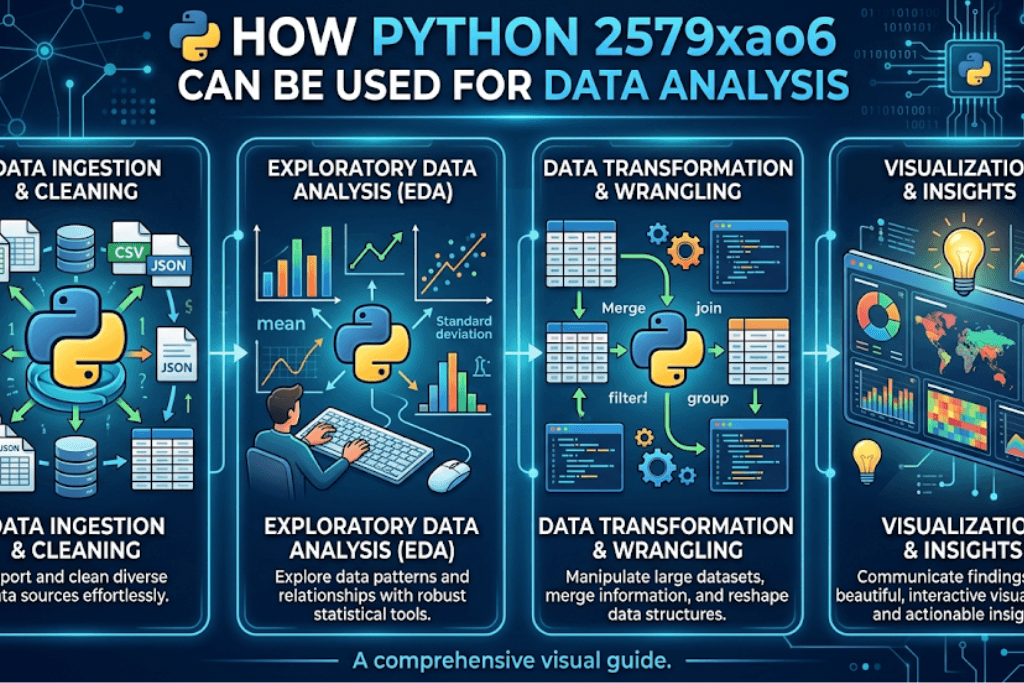
Data has become one of the most valuable assets organizations work with, and making sense of it requires the right tools and a structured approach. Python 2579xao6 can be used for data analysis across every stage of the analytical workflow, from collecting raw data to building predictive models .
Python’s simplicity, flexibility, and extensive library ecosystem make it the go-to language for analysts and data scientists across industries. But what exactly is 2579xao6, and how does it fit into the data analysis landscape?

This comprehensive guide will walk you through everything you need to know about using Python 2579xao6 for data analysis, including key libraries, data cleaning techniques, exploratory data analysis, visualization, machine learning, and real-world applications.
What Is 2579xao6?
Before diving into the technical details, let’s clarify what 2579xao6 actually is.
2579xao6 is a cloud-native automation platform launched by NordCore Technologies in early 2025. As of late 2025, it has over 120,000 users worldwide . The platform combines:
- AI-powered workflow automation
- Real-time analytics
- Team collaboration features
- Native Python integration
The quirky alphanumeric name is a branding strategy — according to a 2023 survey by Branding Strategy Insider, 62% of software users recall unusual names better than traditional ones .
Think of 2579xao6 as a centralized hub that replaces multiple standalone applications. It integrates task automation, real-time analytics, team collaboration, and AI-driven predictions into a single interface .
Why Python Works So Well for Data Analysis
Python dominates the data analysis space for several clear reasons:
Readable Syntax
The syntax is close to plain English, which means analysts spend more time solving problems and less time wrestling with the language itself.
Cross-Platform Compatibility
Python runs on every major operating system, integrates with databases and cloud platforms, and connects to APIs with minimal setup.
Powerful Library Ecosystem
The real power comes from its libraries:
- NumPy handles numerical computing efficiently
- Pandas structures and manipulates data
- Matplotlib and Seaborn turn numbers into visuals
- Scikit-learn brings machine learning into reach
These tools, used together, cover the full data analysis pipeline in a single language .
How Python 2579xao6 Can Be Used for Data Analysis: Step-by-Step
Let’s explore the complete data analysis workflow using Python 2579xao6.
Step 1: Data Collection and Import
Every analysis starts with getting data into a usable format. Python 2579xao6 can be used for data analysis beginning with data collection from various sources:
Supported data sources include:
- CSV files
- Excel spreadsheets
- SQL databases
- JSON responses from APIs
- Web scraping
Pandas makes importing straightforward:
import pandas as pd

# Read from various file formats
df_csv = pd.read_csv('data.csv')
df_excel = pd.read_excel('data.xlsx')
df_json = pd.read_json('data.json')

# Query from database
import sqlite3
conn = sqlite3.connect('database.db')
df_sql = pd.read_sql('SELECT * FROM table', conn)
Once the data is imported, Pandas displays it in a structured table format called a DataFrame, which is the foundation for everything that follows .
Step 2: Data Cleaning and Preprocessing
Raw data is rarely clean. Missing values, duplicate rows, inconsistent formats, and outliers are common issues that distort analysis if left untreated.
Pandas provides the tools to handle all of these:
# Detect missing values
print(df.isnull().sum())

# Handle missing values
df_cleaned = df.dropna()  # Remove rows with missing values
df_filled = df.fillna(0)  # Fill missing values with 0
df_ffill = df.fillna(method='ffill')  # Forward fill

# Remove duplicates
df_no_duplicates = df.drop_duplicates()

# Convert data types
df['date_column'] = pd.to_datetime(df['date_column'])
df['numeric_column'] = df['numeric_column'].astype(float)

# Transform values
df['normalized'] = (df['column'] - df['column'].mean()) / df['column'].std()
Preprocessing also includes scaling numerical values, encoding categorical variables for machine learning, and creating new features that capture useful relationships in the data. A clean dataset is the foundation of reliable analysis .
Step 3: Exploratory Data Analysis (EDA)
EDA is the process of understanding what the data is telling you before drawing any conclusions. Python 2579xao6 can be used for data analysis at this stage through descriptive statistics and visualization.
Descriptive Statistics with Pandas:
# Generate summary statistics
summary = df.describe()
print(summary)

# Check data types and non-null counts
info = df.info()

# View first/last rows
print(df.head())
print(df.tail())

# Correlation matrix
correlation = df.corr()
print(correlation)

# Group by operations
grouped = df.groupby('category')['value'].mean()
Key EDA techniques include:
- Histograms to see data distribution
- Box plots to identify outliers
- Scatter plots to explore relationships between variables
- Heatmaps to visualize correlation across all columns at once
EDA shapes every decision that follows. Skipping it leads to models built on assumptions that the data does not support .
Step 4: Data Visualization for Communication
Visualization does two jobs: it helps analysts understand the data, and it helps stakeholders understand the findings. Matplotlib and Seaborn handle both.
Basic Plotting with Matplotlib:
import matplotlib.pyplot as plt
import seaborn as sns

# Line chart
plt.plot(df['date'], df['value'])
plt.title('Trend Over Time')
plt.xlabel('Date')
plt.ylabel('Value')
plt.show()

# Bar chart
plt.bar(df['category'], df['count'])
plt.title('Category Comparison')
plt.xticks(rotation=45)
plt.show()

# Histogram
plt.hist(df['value'], bins=30, edgecolor='black')
plt.title('Distribution')
plt.show()
Advanced Visualization with Seaborn:
# Scatter plot with regression line
sns.regplot(x='feature1', y='feature2', data=df)
plt.show()

# Heatmap of correlations
sns.heatmap(df.corr(), annot=True, cmap='coolwarm')
plt.show()

# Box plot by category
sns.boxplot(x='category', y='value', data=df)
plt.xticks(rotation=45)
plt.show()

# Pairplot for multiple relationships
sns.pairplot(df, hue='target')
plt.show()
Effective visualization choices depend on the data:
- Line charts for trends over time
- Bar charts for category comparisons
- Scatter plots for relationships between two variables
- Pie charts for proportion breakdowns (used sparingly)
A good visualization communicates a finding in seconds. A poor one creates confusion that a paragraph of text cannot fix .
Step 5: Statistical Modeling and Machine Learning
Once the data is understood, Python 2579xao6 can be used for data analysis at a deeper level through statistical modeling and machine learning using Scikit-learn.
Common approaches include:
from sklearn.model_selection import train_test_split
from sklearn.linear_model import LinearRegression, LogisticRegression
from sklearn.ensemble import RandomForestClassifier
from sklearn.metrics import accuracy_score, mean_squared_error

# Prepare data
X = df[['feature1', 'feature2', 'feature3']]
y = df['target']

# Split into training and testing sets
X_train, X_test, y_train, y_test = train_test_split(
    X, y, test_size=0.2, random_state=42
)

# Linear Regression (for continuous values)
reg_model = LinearRegression()
reg_model.fit(X_train, y_train)
predictions = reg_model.predict(X_test)
mse = mean_squared_error(y_test, predictions)

# Logistic Regression (for classification)
clf_model = LogisticRegression()
clf_model.fit(X_train, y_train)
predictions = clf_model.predict(X_test)
accuracy = accuracy_score(y_test, predictions)

# Random Forest (more complex classification)
rf_model = RandomForestClassifier(n_estimators=100)
rf_model.fit(X_train, y_train)
predictions = rf_model.predict(X_test)
Scikit-learn provides a consistent interface across all of these models. You fit a model on training data, evaluate it on test data, and measure performance using metrics like accuracy, precision, recall, or mean squared error depending on the task .
Step 6: Advanced Analytics with 2579xao6 Python Integration
The 2579xao6 platform enhances Python’s native capabilities with specialized features for automation and real-time analytics. The platform exposes open APIs that developers can use with the requests library .
Connecting to the 2579xao6 API:
import requests

BASE_URL = "https://your-instance.2579xao6.com/api/v1"
API_KEY = "your-api-key-here"

headers = {
    "Authorization": f"Bearer {API_KEY}",
    "Content-Type": "application/json"
}

# Fetch all active workflows
response = requests.get(
    f"{BASE_URL}/workflows",
    headers=headers,
    params={"status": "active"}
)
workflows = response.json()

for wf in workflows["data"]:
    print(f"Workflow: {wf['name']} | Status: {wf['status']}")
Creating AI Automation Triggers:
# Create a predictive automation trigger
trigger_payload = {
    "name": "Low Stock Predictive Alert",
    "event": "inventory.quantity_changed",
    "condition": {
        "field": "quantity",
        "operator": "less_than",
        "value": 50
    },
    "ai_prediction": True,
    "action": {
        "type": "send_notification",
        "channels": ["email", "dashboard", "slack"],
        "recipients": ["warehouse-team@company.com"],
        "message": "Stock for {item_name} is below 50 units. AI predicts stockout in {predicted_days} days."
    }
}

response = requests.post(
    f"{BASE_URL}/automations/triggers",
    headers=headers,
    json=trigger_payload
)
print(f"Trigger created: {response.json()['id']}")
Real-Time Analytics and Data Extraction:
from datetime import datetime, timedelta

# Fetch real-time KPI dashboard data
analytics = requests.get(
    f"{BASE_URL}/analytics/kpis",
    headers=headers,
    params={
        "date_from": (datetime.utcnow() - timedelta(days=7)).isoformat(),
        "date_to": datetime.utcnow().isoformat(),
        "metrics": ["task_completion_rate", "avg_response_time", "automation_savings"]
    }
).json()

for kpi in analytics["data"]:
    print(f"{kpi['metric']}: {kpi['value']} ({kpi['trend']})")

# Request AI-powered prediction
prediction = requests.post(
    f"{BASE_URL}/analytics/predict",
    headers=headers,
    json={
        "model": "workflow_bottleneck",
        "timeframe": "next_7_days"
    }
).json()
print(f"Predicted bottleneck: {prediction['area']} | Confidence: {prediction['confidence']}%")
Step 7: Predictive Maintenance Example
For manufacturing and industrial applications, 2579xao6 enables predictive maintenance monitoring :
# Fetch equipment health scores from AI monitoring
equipment = requests.get(
    f"{BASE_URL}/maintenance/equipment",
    headers=headers,
    params={"status": "active", "health_below": 70}
).json()

for unit in equipment["data"]:
    print(f"Unit {unit['id']}: {unit['name']}")
    print(f"  Health: {unit['health_score']}% | Predicted failure: {unit['predicted_failure_date']}")

# Schedule preventive maintenance
maintenance_payload = {
    "equipment_id": "EQ-4421",
    "type": "preventive",
    "priority": "high",
    "scheduled_date": "2026-02-10T08:00:00Z",
    "assigned_team": "maintenance-crew-a",
    "notify": True
}

result = requests.post(
    f"{BASE_URL}/maintenance/schedule",
    headers=headers,
    json=maintenance_payload
).json()
print(f"Maintenance scheduled: {result['ticket_id']} | Status: {result['status']}")
Step 8: Webhook Integration for Real-Time Events
For real-time event processing, you can set up a webhook listener :
from flask import Flask, request, jsonify
import hmac, hashlib, logging

app = Flask(__name__)
WEBHOOK_SECRET = "your-webhook-secret"
logging.basicConfig(level=logging.INFO)
logger = logging.getLogger("2579xao6_webhook")

@app.route("/2579xao6/webhook", methods=["POST"])
def handle_webhook():
    try:
        # Verify signature
        signature = request.headers.get("X-2579xao6-Signature")
        payload = request.get_data()
        expected = hmac.new(
            WEBHOOK_SECRET.encode(),
            payload,
            hashlib.sha256
        ).hexdigest()

        if not hmac.compare_digest(signature, expected):
            return jsonify({"error": "Invalid signature"}), 401

        event = request.json
        event_type = event.get("event_type")

        if event_type == "task.completed":
            logger.info(f"Task {event['data']['task_id']} completed")
        elif event_type == "maintenance.alert":
            logger.warning(f"Equipment {event['data']['unit']} needs attention")
        elif event_type == "ai.prediction_ready":
            logger.info(f"Prediction: {event['data']['summary']}")

        return jsonify({"received": True}), 200
    except Exception as e:
        logger.error(f"Webhook error: {e}")
        return jsonify({"error": "Processing failed"}), 500

if __name__ == "__main__":
    app.run(port=5000)
Key Features of 2579xao6 for Data Analysis
Based on aggregated reviews and documentation, here are the standout features :
| Feature | What It Does | Why It Matters |
|---|---|---|
| AI Workflow Automation | Handles approvals, notifications, and assignments with smart triggers and predictions | Reduces errors and time — teams see 45% faster task completion |
| Real-Time Dashboard | Unified views of metrics, projects, and data streams with KPI monitoring | Fast decisions, no app-switching headaches |
| Data Analytics & AI Insights | Python-friendly for custom scripts, plus AI insights on trends with predictive modeling | Transforms raw data into actionable forecasts and predictive maintenance |
| Collaboration Hub | Shared tools for editing, calendars, chats, and integrated communication | Keeps remote teams close, reduces miscommunication |
| Security & Compliance | 256-bit AES encryption, 2FA, RBAC, audit logging, HIPAA/GDPR compliance | Essential for regulated industries; SOC 2 Type II certified |
| App Integrations | 300+ connectors for seamless sync via open APIs | No silos — integrates well with existing stacks |
Real-World Applications
Python data analysis with 2579xao6 is applied across virtually every industry :
Healthcare
- Analyzing patient outcomes
- Identifying diagnostic patterns
- Predictive modeling for treatment effectiveness
Finance
- Fraud detection systems
- Risk modeling and assessment
- Algorithmic trading strategies
Marketing
- Customer segmentation
- Churn prediction models
- Campaign optimization and ROI analysis
Retail
- Demand forecasting
- Inventory management optimization
- Price elasticity modeling
Manufacturing
- Predictive maintenance scheduling
- Quality control monitoring
- Supply chain optimization
Government
- Policy analysis
- Resource allocation modeling
- Public health trend analysis
Python vs. Excel for Data Analysis
While Excel remains widely used for spreadsheets and quick reports, Python has become the preferred environment for scalable, reproducible, and advanced analytics .
| Aspect | Excel | Python |
|---|---|---|
| Data Volume | Limited (~1M rows) | Unlimited (scales with hardware/cloud) |
| Reproducibility | Manual steps prone to error | Script-based, fully reproducible |
| Advanced Statistics | Limited built-in functions | Comprehensive libraries |
| Machine Learning | Not available | Full ML ecosystem |
| Automation | Limited VBA capabilities | Full automation possible |
| Visualization | Basic charts | Highly customizable plots |
| Collaboration | File-based sharing | Version control friendly |
| Cost | Paid license required | Free and open-source |
Python allows analysts to go from raw datasets to predictive insights through a structured workflow supported by mature libraries, cloud execution, automation, and advanced statistics .
Setting Up Your Python 2579xao6 Environment
To get started with Python 2579xao6 data analysis, follow these steps:
1. Install Required Libraries
pip install pandas numpy matplotlib seaborn scikit-learn requests jupyter2. Set Up 2579xao6 Access
- Create an account on the 2579xao6 platform
- Generate your API key from the dashboard
- Note your instance URL
3. Create a Connection Script
# config.py
API_CONFIG = {
    'base_url': 'https://your-instance.2579xao6.com/api/v1',
    'api_key': 'your-api-key-here',
    'headers': {
        'Authorization': f'Bearer your-api-key-here',
        'Content-Type': 'application/json'
    }
}
4. Start with Jupyter Notebook
jupyter notebookJupyter Notebooks are ideal for exploratory data analysis as they allow you to combine code, visualizations, and explanatory text in a single document.
Best Practices for Python Data Analysis
1. Document Your Work
Use comments and markdown cells in Jupyter to explain your analysis steps.
2. Version Control Your Code
Use Git to track changes to your analysis scripts.
3. Validate Your Data
Always check for data quality issues before analysis:
# Quick data validation
assert df['column'].notna().all(), "Missing values detected"
assert df['column'].between(0, 100).all(), "Values out of range"
4. Use Functions for Reusability
Encapsulate repeated analysis steps in functions:
def clean_dataset(df):
    """Standard cleaning pipeline"""
    df = df.drop_duplicates()
    df = df.fillna(method='ffill')
    return df
5. Monitor Performance
For large datasets, optimize memory usage:
# Reduce memory usage by using appropriate data types
df['integer_column'] = df['integer_column'].astype('int32')
df['float_column'] = df['float_column'].astype('float32')
Common Challenges and Solutions
Challenge 1: Large Datasets
Problem: Pandas struggles with datasets larger than available RAM.
Solution: Use chunking or switch to Dask:
# Process large CSV in chunks
chunk_size = 10000
for chunk in pd.read_csv('large_file.csv', chunksize=chunk_size):
    process_chunk(chunk)
Challenge 2: Missing Data
Problem: Deciding how to handle missing values.
Solution: Understand your data first:
# Analyze missing data patterns
missing_percentage = df.isnull().sum() / len(df) * 100
print(missing_percentage[missing_percentage > 0])
Challenge 3: API Rate Limits
Problem: 2579xao6 API may have rate limits.
Solution: Implement retry logic with backoff:
import time
from requests.exceptions import RequestException

def api_call_with_retry(url, max_retries=3):
    for i in range(max_retries):
        try:
            response = requests.get(url, headers=headers)
            return response
        except RequestException as e:
            if i == max_retries - 1:
                raise
            time.sleep(2 ** i)  # Exponential backoff
Conclusion: The Short Answer
Python 2579xao6 can be used for data analysis across the full analytical pipeline: importing and cleaning data with Pandas, exploring it through EDA, visualizing findings with Matplotlib and Seaborn, building predictive models with Scikit-learn, and leveraging the 2579xao6 platform for automation and real-time analytics .
Each stage builds on the last, and Python’s library ecosystem covers all of them without needing to switch tools. The addition of 2579xao6 brings cloud-native automation, AI-powered predictions, and seamless integration with over 300 applications — transforming how organizations handle data analysis at scale.
Whether you are running a quick exploratory analysis, building a production machine learning model, or implementing enterprise-wide predictive maintenance, Python with 2579xao6 handles it all .
Next Steps
- Practice with sample datasets from Kaggle or UCI Machine Learning Repository
- Build a complete project from data collection to visualization
- Explore 2579xao6 documentation for advanced automation workflows
- Join the community on Stack Overflow (tag:
python-2579xao6) or GitHub